Berrettini-Nakashima: the rematch hinges on the second serve
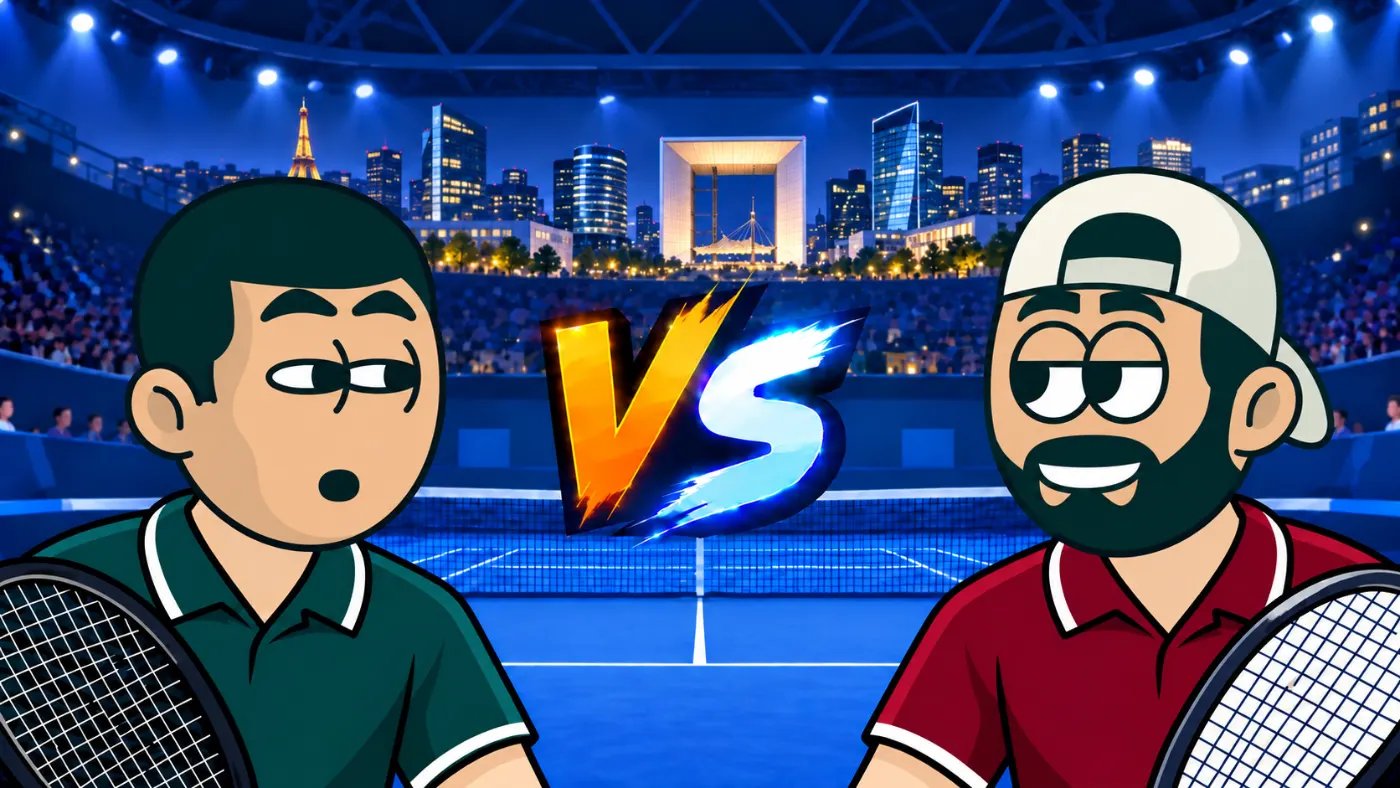
Matteo Berrettini and Brandon Nakashima meet again in the first round of the Rolex Paris Masters less than a month after Shanghai, where the American won 7-6, 7-5 in just under two hours. Berrettini lost that match in the return games, on Nakashima's second serve and on the break points he had created. In Paris he starts from the same problem, on a court that played slow a year ago.
Shanghai: the match lost on return
The Italian hit 12 aces. Nakashima won the first-set tie-break 7-4 and the second set 7-5.
Points won by Nakashima on his second serve: 20 out of 30.
That is where the match was lost. Nakashima hit more second serves than Berrettini, nine more, and still lost only ten of those points. On a second serve Berrettini should turn onto his forehand and take control of the rally from the first shot. On the backhand side, his weaker one, he often blocks or slices the return, and against Nakashima's two-handed backhand that return brings the rally back to neutral.
Recent weeks: the serve holds, the return does not
Since Shanghai, Berrettini's script has repeated itself. In Lyon he lost in the first round to Kyrian Jacquet by the same score, 7-6, 7-5, converting zero of five break points. In Vienna he beat Tomas Martin Etcheverry 6-3, 6-4, then reached the quarter-finals after Flavio Cobolli retired at 5-2.
The serve keeps winning him games and sets. What is missing is converting his return chances.
Nakashima has lost two matches in a third-set tie-break. In the tournament after Shanghai he lost to Alexander Bublik 6-7, 6-3, 7-6. In Vienna he went out in the first round against Tallon Griekspoor, 6-1, 4-6, 7-6. In between, in Lyon, he reached the quarter-finals and lost in three sets to Cobolli. Bublik and Griekspoor took him to a deciding tie-break, where consistency from the baseline counts for less.
The court at La Défense
In 2025 the organizers slowed the surface down, and tournament director Cédric Pioline confirmed it was deliberate. Bublik called it the slowest indoor court he had ever played on. If the speed stays the same, Berrettini's first serve earns fewer direct points and more returns come back into play. Rallies get longer, and the player who makes fewer errors from the baseline counts for more. That is Nakashima's terrain.
On a slow surface, though, Berrettini has more time to move onto his forehand when returning the second serve, the shot that was missing in Shanghai.
Nakashima starts with a slight edge: on a slow court he can lengthen the rallies and take the quick points away from Berrettini. It is still a near-even match, because Berrettini reached the quarter-finals in Vienna and Nakashima lost in the first round to Griekspoor. The prediction falls apart if Berrettini converts one of the first break points of the match and turns onto his forehand to return the second serve: with his serve, one break up is enough to close out a set. If instead the match goes to tie-breaks again with Berrettini wasting his return chances, the Shanghai result repeats itself. There is also a physical variable: in Lyon Berrettini called a medical timeout after the first-set tie-break.