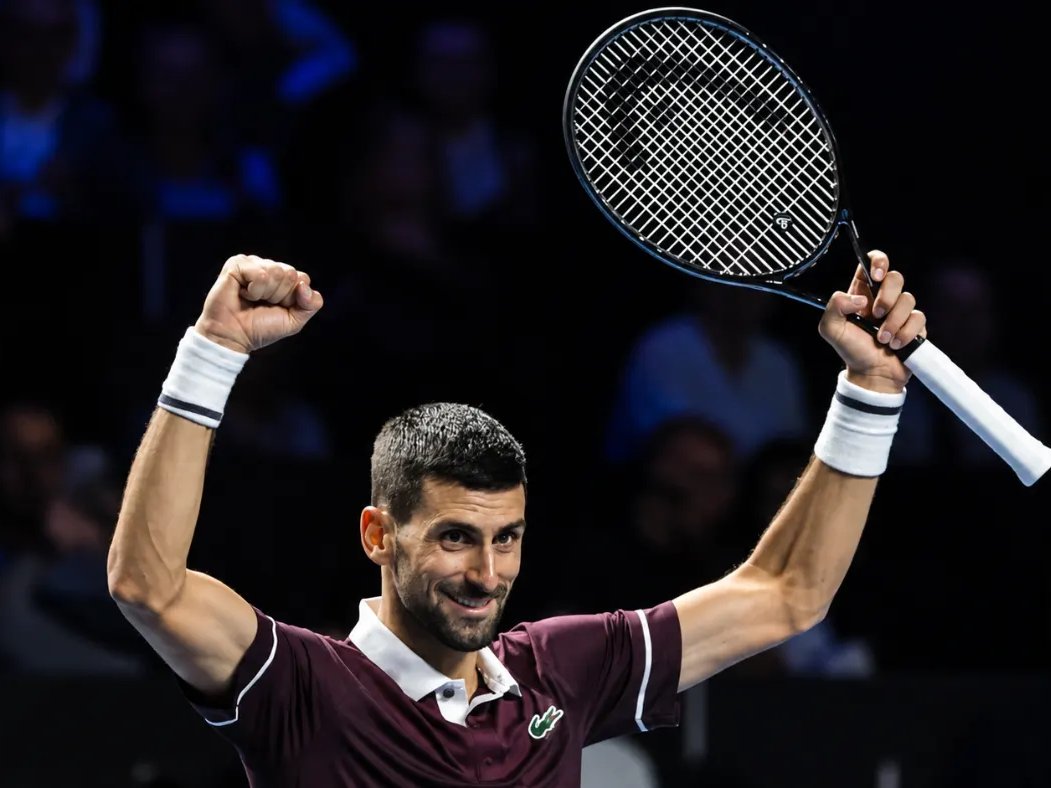
Djokovic-Vacherot in Paris: the wise old man against the fresh champion

Novak Djokovic, the No. 10 seed, opens the Rolex Paris Masters against Valentin Vacherot, who beat him 6-3, 6-4 in the Shanghai 2025 semifinal, their only previous meeting. The first round will be decided in the Serbian's return games. If Djokovic gets the Monegasque's first serve back deep, the rallies lengthen and the edge moves to him. If he can't, Vacherot holds in a few shots and the match drifts toward tie-breaks.
Vacherot's first serve
In Shanghai, Vacherot won 28 of the 36 points he played on his first serve. Djokovic broke him in the opening game, and the Monegasque broke straight back.
That match has to be read with caution. Djokovic called for medical assistance and was visibly moving badly. Part of those numbers says more about his body than about Vacherot's serve.
Basel, however, showed the same problem with a healthy Djokovic. On Thursday he lost to Jan-Lennard Struff 7-6(4), 5-7, 6-7(5) without ever breaking the German's serve. In a match with at least eighteen return games, that had happened to him only three other times in his career. Struff and Vacherot play a similar game: heavy serve and a forehand straight after it.
Vacherot's serve, meanwhile, is in form. In that same Basel week he hit 20 aces against Holger Rune in the quarterfinals, then beat Taylor Fritz in the semifinal and Jiri Lehecka in Sunday's final, 2-6, 6-3, 6-3.
Where Djokovic can win points
The target is Vacherot's second serve. On that ball Djokovic can return deep down the middle, take the angle away from the Monegasque's forehand and seize control of the point immediately. In Basel, Vacherot beat Rafael Jodar only in a third-set tie-break, 7-6(4), 2-6, 7-6(5): his service games hold up, but the margins narrow when the opponent forces him to hit the second serve.
The second key is rally length. Vacherot's game is built on the serve and the first forehand. Every point that gets past that phase takes him onto Djokovic's ground, where the Serbian is steadier and more patient from the baseline.
To get there, Djokovic has to choose carefully when to change direction. Against a tall opponent (Vacherot is 1.93 m) who waits for the short ball to hit his forehand, going for the line too early hands the initiative back. The crosscourt backhand, hit deep, is the safest way to move him before opening up the court.
Recovery and surface
Vacherot played the Basel final on Sunday and arrives in Paris with very little recovery, in a different arena. Djokovic has been idle since Thursday. In a first-round match, fresh legs matter most in the third set.
Then there is the court. In 2025, the first year at La Défense Arena (now Plenitude Arena), the surface was slowed down sharply compared with the old Bercy, with the Court Pace Index dropping to 35.1. Alexander Bublik called it the slowest indoor court he had ever played on. If conditions stay the same as in 2025, Djokovic's return will have more time than it had in Basel.
Djokovic starts with a slight edge, because Vacherot's second serve and a slow court give him on return the points Struff didn't concede. But his name weighs on the prediction more than his return form of recent weeks does, and the Monegasque arrives with a title won on Sunday. The pick falls apart if Vacherot gets at least 65% of his first serves in and holds without being dragged into long rallies. In that case the sets go to tie-breaks, and in Basel Djokovic lost exactly the deciding tie-break against Struff.