Djokovic and the 21 seasons: the record worth more than 103
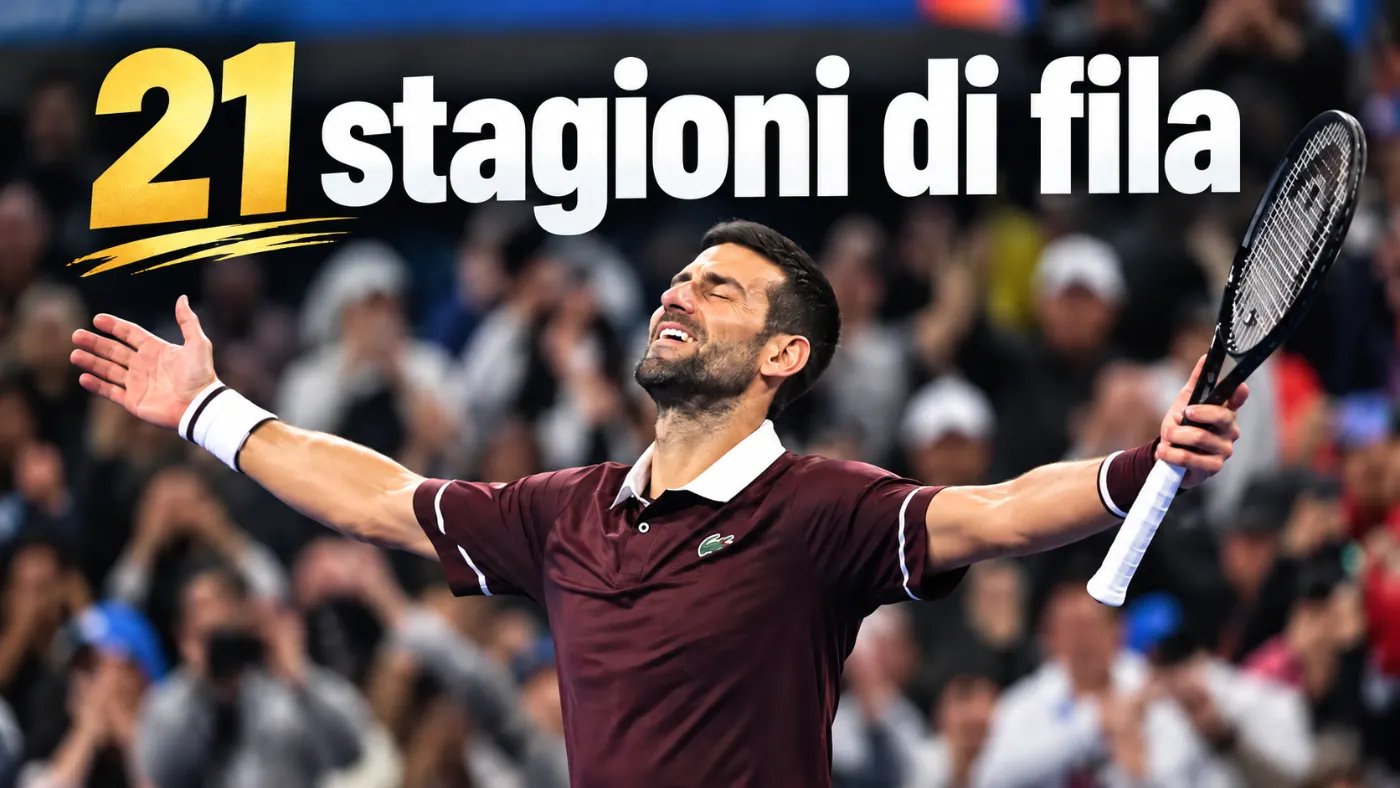
The number everyone is watching now is 103. On Tuesday, October 6, in Beijing, Novak Djokovic won ATP title No. 102, moving within one of Roger Federer and seven of Jimmy Connors. The countdown has started, and once he draws level with Federer, it will swallow every other storyline.
The week's most important record is a different one, though. With the China Open, Djokovic has won at least one title in 21 consecutive seasons, from 2006 to 2026. No man in the Open Era had got there: Rafael Nadal stopped at 19, Federer at 15. The 103 measures how much you won. The 21 seasons measure that you never stopped winning, and that is the definition of longevity Djokovic has imposed on tennis.
The years the streak should have broken
The first title came on July 23, 2006, in Amersfoort, in the Netherlands: 7-6 6-4 over Nicolás Massú, at 19. The most recent came at 39, against Alex de Minaur. A streak this long is judged by its worst years, and Djokovic has lived through at least three.
In 2017 his right elbow had been tormenting him for a year and a half. He retired in the Wimbledon quarterfinals against Tomas Berdych and ended his season in July, missing the US Open for the first time in his career. He had already won Doha, beating Andy Murray in the final, and Eastbourne. That was enough.
In 2022 he was deported from Australia in January and then kept out of the US Open and the entire North American hard-court swing because he was unvaccinated. He still won Rome, Wimbledon, Tel Aviv, Astana and the ATP Finals in Turin.
2026 was the most fragile of the three. A lost final in Melbourne against Carlos Alcaraz, then months of physical problems and no trophy until October. He arrived in Beijing ranked No. 11 in the world, and the streak depended on that week or the ones after it.
"It's been a difficult year, but I'm still here, and I'm making the young guys earn their money,"
he said after beating Alexander Zverev in the quarterfinals.
The objection: a gifted title
Anyone who wants to cut the record down to size has an easy argument, and it deserves to be taken seriously. The title that kept the streak alive came without Djokovic finishing either of his last two matches. In the semifinal, Daniil Medvedev was disqualified after hitting a spectator with a ball. In the final, de Minaur lost the first-set tie-break 7-3, left the court for treatment on his groin and retired shortly afterward. A 21-season streak saved by a disqualification and an injury looks like an accountant's record.
The objection describes the final well and the streak badly. Over 21 years there are titles built against opponents who are falling apart and titles wrested from players at their peak, and the streak makes no distinction between the two. It asks for one thing only: to be there, in good enough shape, the week the others give way. To be there in Beijing, Djokovic had beaten Zverev, the No. 1 seed, 4-6 6-4 6-4. According to ATP data, he is the oldest winner of a 500 event since the category was created in 2009. He left Beijing with a record of 34 wins and no losses in seven appearances.
Federer's 2016
There is a more serious objection, and it concerns Federer himself. His streak ended in 2016. In February he tore the meniscus in his left knee, the first surgery of his career, and on July 26 he shut down his season to avoid further damage. For the first time since 2000, a year ended without a title. In 2017 he came back and won the Australian Open and Wimbledon, then Melbourne again in 2018: three Slams after the age of 35, bought with a year off.
So the streak does not measure greatness. Federer chose to stop and he was right. On that point the objection holds.
The streak measures something else: how two champions aged. Federer won his 103 titles across 18 different seasons, with a gap in the middle and three trophyless years at the end. His last title came in Basel in 2019, at 38, 6-2 6-2 over de Minaur. After that, nothing until his retirement in 2022. Federer's longevity is the story of a pause and a return.
Djokovic has spread his 102 titles across 21 seasons, without a break. He is already older than Federer was when he won his last title, and he got there by beating the same opponent in the final. His longevity is an unbroken line, drawn even in the years when his body or politics took half the calendar away.
The number nobody will chase
The 103 is a milestone others may come close to. The 21 asks for more. Jannik Sinner won his first title in Sofia in 2020. To match Djokovic he would have to win at least one every year until 2040, when he will be 39. Every long injury, every bad season that ends in November empty-handed, resets the count to zero.
Federer was right to take his year off. Djokovic never took his.