Berrettini-Davidovich in Tokyo: who controls the duration
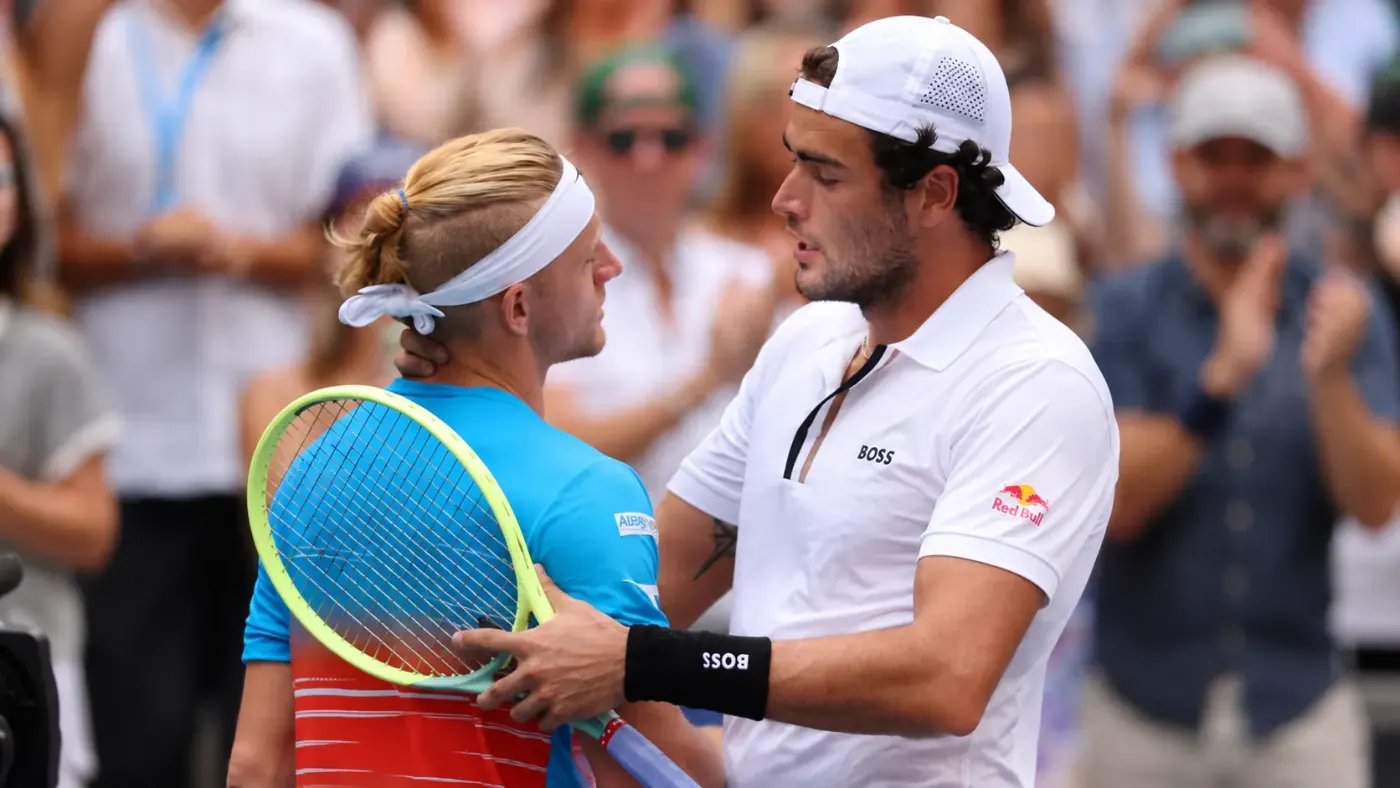
The first round of the ATP 500 Tokyo pits Matteo Berrettini against Alejandro Davidovich Fokina on the outdoor hard courts of the Ariake Coliseum, and one variable decides this match: average rally length. The Spaniard arrives from Chengdu with the first hard-court title of his career, four matches in his legs, and just one set dropped all week. The Italian hasn't played an official match since September 2, when he lost in the second round of the US Open to Mariano Navone 3-6, 6-3, 6-4, 7-6(4) in three hours and twenty-nine minutes.
What Chengdu changed in Davidovich's serve
The serve has historically been the point of attack against Davidovich Fokina. At Chengdu that point of attack closed up. In the final against Hubert Hurkacz he landed 77% of first serves, won 87% of points on the first serve (46 of 53), held all eleven service games, and faced just one break point, which he saved.
It's a one-match statistical sample, not a season's worth. But it's exactly the kind of performance that strips Berrettini of his simplest plan: break serve once and hold his own. If Davidovich serves at that level, the Italian has to win the match inside his own service games, with minimal margins and no safety net.
The four-shot threshold
Berrettini's blueprint on hard courts hasn't changed: heavy first serve, forehand on the short return, point closed out within the first three or four shots. It works when the first serve is landing and when his forehand timing matches a season played in rhythm. Neither is guaranteed after four weeks without a match, in a 2026 fragmented by his January withdrawal from the Australian Open and the early-July diagnosis of chronic hip pain, which came after his third-round exit at Wimbledon.
Davidovich Fokina plays the opposite game by design. He thrives on rallies that stretch out, moves his opponent on the diagonal, and uses the drop shot as a systematic weapon rather than a one-off flourish ("the drop shot is part of me", he said in 2019). Against a tall player with a recent history of hip trouble and lateral movement still to rebuild, the repeated drop shot isn't there to win the point: it's there to load his legs for the third set.
Their head-to-head points the same way. The two have met twice, split 1-1: Davidovich won at Monte Carlo 2021, 7-5, 6-3, and Berrettini took the US Open 2022 fourth round 3-6, 7-6(2), 6-3, 4-6, 6-2 in over three hours and forty minutes. Berrettini's only win came on hard court, but it took almost four hours, and it came when he was the 13th seed at a Slam, with a full season of matches behind him.
The counter-argument: the Chengdu week has a cost
Davidovich Fokina hadn't played since the Umag quarterfinal in July, skipping Montreal, Cincinnati, and the US Open with a back problem. At Chengdu he won four matches, closing out the final on Tuesday, with the Tokyo draw opening the next day on the other side of the continent. A title won on the way back from a two-and-a-half-month layoff is a peak, and here that peak arrives with no recovery day in between. His ranking also tells the story of a broken-up year, well off the career-high 14 he reached last November.
Berrettini, outside the top forty, starts a slight underdog, not a heavy one. The pick is Davidovich Fokina in three sets, with the match tilting toward the Spaniard every time the rally passes the fifth shot. The condition that flips it is measurable from the first set: if Berrettini stays above 65% first serves and keeps winning the points decided within four shots, he wins in two, because at that point Davidovich has to find break points against a serve that gives him no time to build the point, and he has to do it with a back that just absorbed a full week of matches. If the first set runs past fifty minutes, though, the match already belongs to the Spaniard.