Musetti-Hurkacz in Paris: slice against the first serve
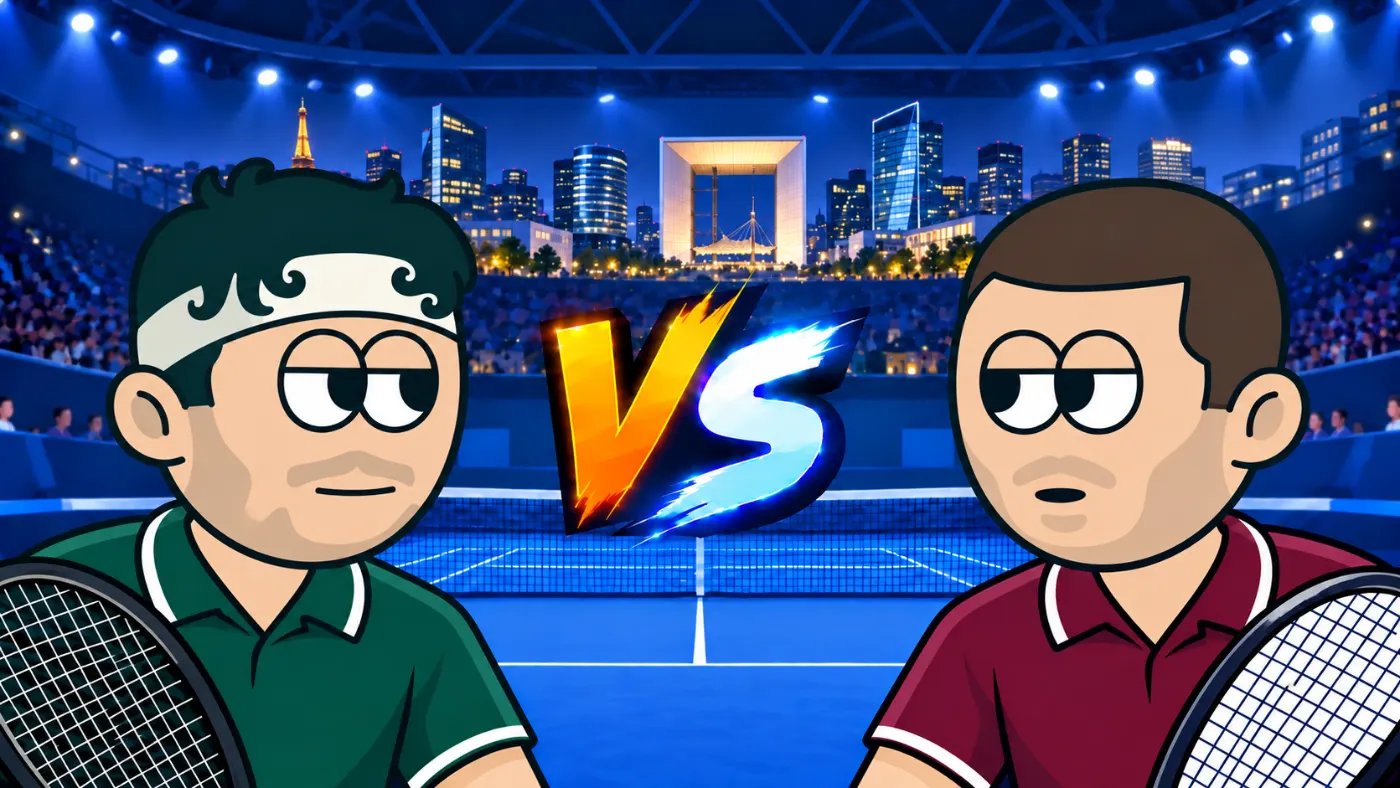
Lorenzo Musetti and Hubert Hurkacz meet in the first round of the Rolex Paris Masters for the right to face Alexander Zverev, the top seed, in the second. The match comes down to one specific question: how many of the Pole's service games Musetti can turn into rallies by keeping the ball low with the slice backhand. If the exchange gets longer, the Italian starts ahead. If Hurkacz closes out his games with the serve and the next shot, it goes to a tie-break and the forecast opens up.
Hurkacz's first serve and the La Défense court
Hurkacz arrives with his serve in form. In the second round in Shanghai he beat Novak Djokovic 6-4, 6-3, holding all ten of his service games, with 13 aces and 82% of points won on the first serve. It was his first win over the Serb after eight defeats. At that level, the opponent's return touches few playable balls, and the Pole builds the point on serve and forehand: a flat first serve, then the forehand on the short return.
The court can take something away from him. In 2025, the first year at La Défense, the organizers slowed the surface after a 2024 edition judged too fast, and Alexander Bublik called it the slowest indoor court he had ever played on. If the surface stays the same as last year, Hurkacz wins fewer direct points and Musetti gets more returns back into play.
The slice backhand as a rally plan
Against a player who stands 1.96 m tall, a low, sliced ball forces him to bend and hit from low to high. From there Hurkacz struggles to accelerate: he has to rally softly or attack the net with a shallow approach, the ball on which Musetti looks for the passing shot or the lob. In Madrid, in their most recent meeting, the Italian saved two set points at 5-6 in the second set and closed out that game with a lob.
In Vienna, on indoor hard, Musetti showed the version of the pattern he needs in Paris. Against Frances Tiafoe, the world No. 9, he built the decisive break in the second set by alternating tight topspin backhands with the slice, up to the down-the-line shot that gave him the break point. He won 7-6, 7-5 without facing a break point, winning 68% of the points on his second serve.
That number matters more than the break. Hurkacz wins by holding serve, and against a Musetti who serves like this he has to find the break in the few return games where he gets into a rally.
Head-to-head: Musetti leads 3-2. The only one on indoor hard, Rotterdam 2022, went to the Italian in three sets.
Both of Hurkacz's wins came at Wimbledon, on grass.
The tie-break as a risk zone
If the serves hold, the match goes to a tie-break, and that is where Hurkacz has left something on the table in his recent outings. In Madrid, in the second-set tie-break, Hurkacz made his first double fault of the match, and Musetti closed it out 7-4. On Wednesday in Basel he lost to Holger Rune 3-6, 6-3, 7-6 after having a match point in the tie-break. That is two episodes, and the sample is small. Still, they show where the Pole's first serve has the least margin: when a minibreak weighs more than an ace.
Then there is fatigue. Musetti won Lyon on October 25 after a quarter-final of more than three and a half hours against Luca Van Assche and a semi-final in which he saved four match points against Flavio Cobolli, then left straight away for Vienna. Hurkacz has been idle since Wednesday, when he went out in Basel.
Musetti starts with a slight edge: he leads the indoor head-to-head, he held serve against Tiafoe without facing a break point, and a slow court like the 2025 one takes away part of Hurkacz's free points. The prediction breaks down in two cases. If the 2026 court plays faster and Hurkacz repeats his Shanghai first-serve numbers, the match becomes a coin flip decided in the tie-breaks. If three consecutive weeks on court weigh on Musetti's legs in the third set, the slice loses depth and the Pole finds the high ball to attack. The winner gets Zverev.